
Sara Crippen - Honorable Mention: Best Call to Action
Americans have noticed that students are increasingly using AI to complete their schoolwork, and we’re worried. A recent nationwide survey of K12 schools found that 39% of teachers and 68% of parents fear that AI is “weakening..writing, reading comprehension, [and] critical thinking”. College students responding to a similar survey reported that AI is “good for…fast answers” but “is making us all lazy.” In my own classroom, students have begun to avoid the challenging writing tasks intended to help them develop career skills.
EdTech companies have stepped up to offer a solution. Since 2023, dozens of companies have promised to detect AI generated writing. Just paste in an essay, click a button, and behold some reassuringly specific number like “95.8% AI”. These software tools are already embedded in many schools. Forty-three percent of K12 teachers said they regularly used AI detectors during the 2025 school year.
We’re skeptical here in higher ed. Many universities discourage the use of AI detectors because of their high failure rates. Dozens of universities, including Yale and Johns Hopkins, disabled TurnItIn’s AI detector in July 2026 after a series of particularly damning studies. But these targeted bans leave the door open for other detectors. Princeton University’s McGraw Center for Teaching and Learning notes that Pangram Labs, “often considered the most accurate,” is especially popular this year. It seems the solution to our AI problem is right on the horizon.
Unfortunately, the worry-free future detectors promise will always remain just out of reach. The McGraw Center noted that Pangram had already faced several challenges to its claimed 1% error rate by May 2026. Still, Pangram is more accurate than the older TurnItIn. If we only want to punish dishonest students, AI detectors may someday be competent to determine whether or not AI was used.
If, on the other hand, we want students to think critically and wrestle with ideas in their writing, we may find that AI detectors only make our AI problem worse. Undergraduates today report “avoiding certain words in essays because it might flag as AI,” and “Constant worry that my work will flag AI detection, even though I have never used AI.”
In Composition Studies, we know that fear leads students to make counterproductive changes to their writing. A landmark study found that plagiarism detectors incorrectly flagged specialized professional vocabulary. Students responded by “writing to the software”, replacing words essential to their profession with generic language that wouldn’t be flagged.
What changes might students make in response to AI detectors? To find out, I fed a detector called GPTZero human-written and AI generated essays to see what it flagged as “human” or “AI-generated”.
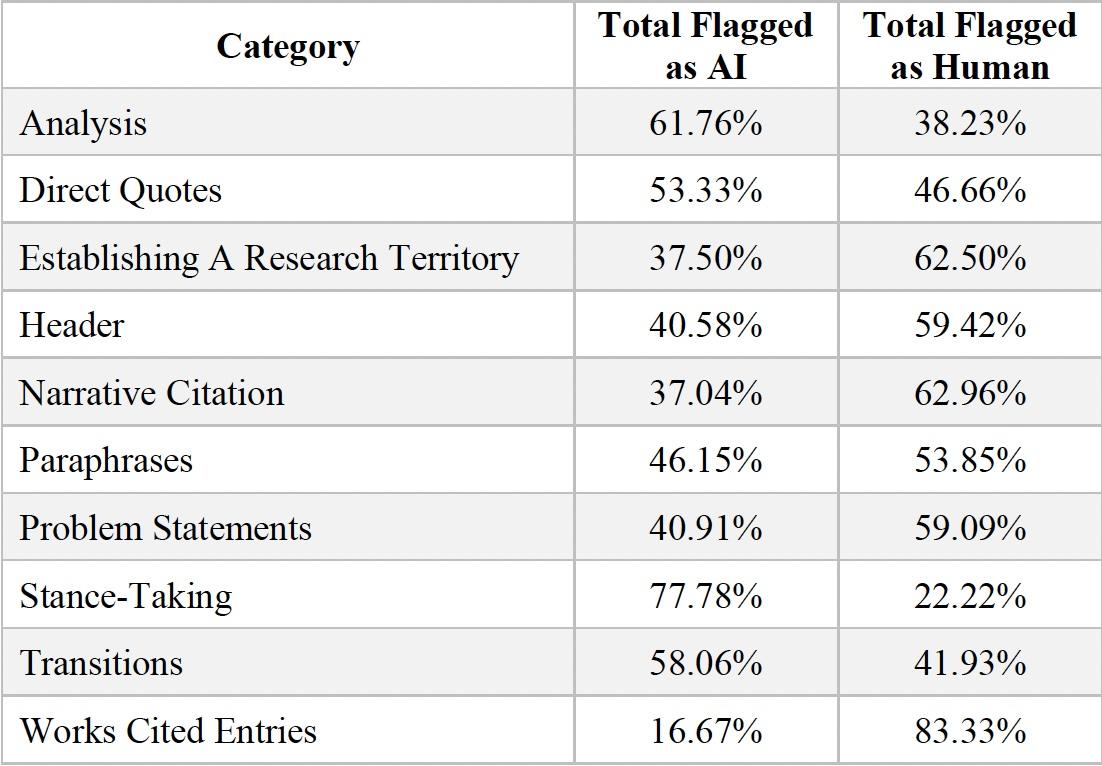
GPTZero considers repetitive structural elements like citations and headers overwhelmingly human. But taking a stand or giving your own analysis of information means you must be a robot. GPTZero, despite its slogan, clearly isn’t going to help us “preserve what’s human.”
If we really want to strengthen writing education in the age of AI, measuring student essays against a software’s idea of humanity isn’t the solution. A machine can’t solve our machine writing problem; it might even frighten us into writing more mechanically.
We have to do the work of preserving and promoting human writing ourselves.
Educators should be open with students about AI detector limitations; ideally, detectors should be replaced with careful attention to writing processes.
Parents should explore options for opting their K12 student out of AI detection programs.
Students shouldn’t let themselves be intimidated by detector results. Software doesn’t define “human writing”, people do!