
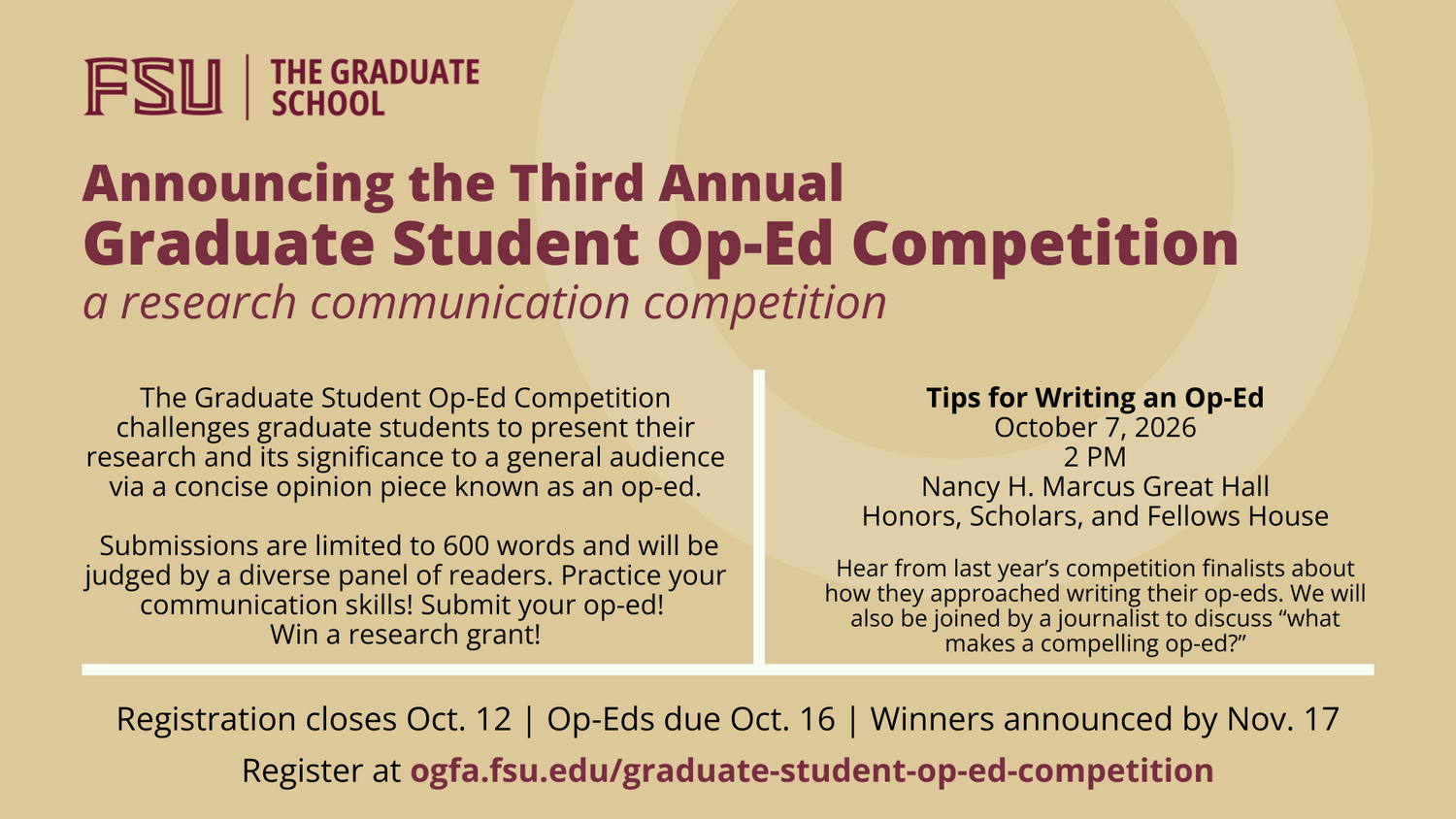
The Graduate Student Op-Ed Competition is an academic research writing competition that challenges graduate students to present their research and its significance to a general audience via a concise opinion piece known as an op-ed. Op-eds are limited to 600 words and will be judged by a diverse panel of readers. The competition occurs each fall semester. All currently enrolled FSU graduate students are eligible to participate.
Click here to Register for the 2026 Op-Ed Competition!
Workshop Video: How to Write an Op-Ed
Read about the 2025 competition and awardees here: FSU Graduate Student Op-Ed Competition showcases excellence in research communication
Learning to communicate with nonexpert audiences is a vital skill for graduate students to develop. As academics and professionals, graduate students work on topics that have public interest and components that are timely and related to current events. By participating in the competition, you will practice the necessary skills to link your research to current events and to communicate clearly with the public. This competition will also help advertise the important research, work in action, and experiences of FSU graduate students to the broader community. Five winners will be chosen, who will each receive a $500 research grant to support their research, education, or professional development.
All currently enrolled (during fall 2026) FSU graduate students are eligible. There are no restrictions on discipline or degree program. Please note, last year's finalists are not eligible to compete this year, but previous honorable mentions are eligible (though they are expected to submit substantially different op-eds than what they previously submitted).
To submit an op-ed for the competition, you must register to participate by October 12. Only registered participants will receive the link to submit their op-eds. Op-eds are due for submission by October 16, 2026.
All submitted op-eds will go through an initial screening to make sure they adhere to the rules outlined below. Those that meet the formatting requirements will then be distributed to a team of judges drawn from different areas of expertise. Every op-ed will be read by at least two judges, who will each assign a point total (20 points maximum). The judges will review each submission for the following:
- Submission clearly establishes the topic’s importance and remains focused on a single issue? (5 points)
- Submission makes strong use of supporting evidence (quotes, experts, data, citations, etc)? (5 points)
- Submission’s language is clear, concise, free of jargon, and appropriate to the topic? (5 points)
- Submission is persuasive and compelling? (5 points)
A strong op-ed should do more than explain an issue. It should take a stance, provide a call to action, or argue in favor of a particular policy or position.
Best Organized Op-Ed
Awarded to the op-ed that demonstrates exceptional structure and clarity throughout, following a standard journalistic structure with a compelling opening, clear thesis, and logical progression.
Best Explanation of Complicated Subject
Awarded to the op-ed that discusses a complicated/complex topic in a clear, understandable manner appropriate for a general reading audience.
Best Use of Evidence
Awarded to the op-ed that most effectively uses evidence (experts, data, cited sources) to support its arguments.
Most Persuasive Argument
Awarded to the op-ed that presents the most compelling and convincing argument, effectively persuading the reader of its viewpoint.
Best Call to Action
Awarded to the op-ed that provides the most powerful and inspiring call to action, motivating readers to engage or take specific steps based on the piece.
Please read and follow the rules and expectations for this competition. Op-ed submissions that do not adhere to the outlined rules will not be accepted for judging.
- Submitted op-eds must have a maximum word count of 600, inclusive of any captions for images/figures.
- Op-eds must be your own original work. No plagiarized or AI-generated submissions will be eligible.
- Op-eds must be written in standard journalism format, with short paragraphs, a strong, informative opening (or “lede” and “nut graf”), and following the “inverted pyramid” structure. Refer to these guides for more information on journalistic style:
- Sources and citations should be included in the article. Use embedded links to cite your sources. No footnotes or “works cited” list should be included.
- Submitted op-eds must be your original work.
- While “timeliness” is an important factor when pitching or submitting op-eds for publication, for the purposes of this competition, op-eds can be responding to/referencing events that happened anytime during the 2025 calendar year.
- Submissions must be in PDF format and following the naming convention “LastName_FirstName_OpEd.PDF” (for example, “McCall_Keith_OpEd.pdf”).
The Conversation is a great resource for learning what an effective op-ed does. The platform hosts op-eds written by university professors, scientists, and other experts.
For guides on how to write in journalism style:
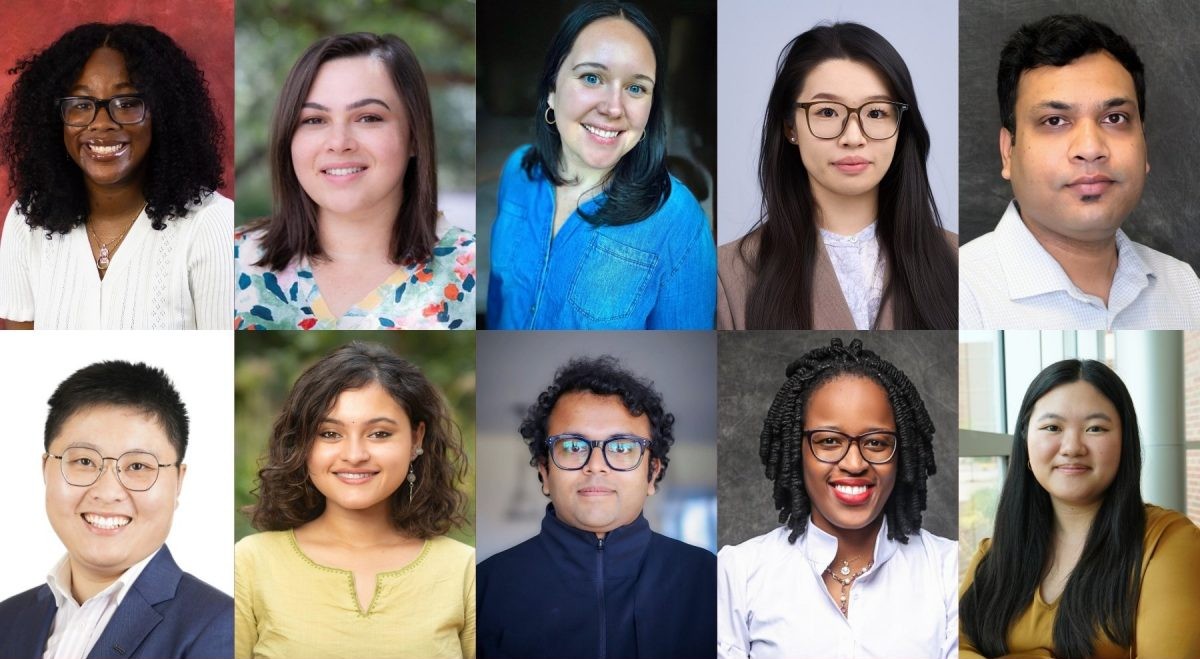
Please review the op-eds written by the 2025 Competition's award winners here. Each of these op-eds adheres to the competition format and rules. Click the hyperlinked names to read the article:
- Savoya Simone Joyner: “The Key to Solving Sex Differences in Obesity Lies in Women’s Brains — If We Choose to See It”
- Suzy Ji: “Stop Treating Asian American Students as a Monolith”
- Sarah Lovins Bacani: “The Hidden Curriculum of Care”
- Rachel Flemming: “Research-Based Teaching Helps Students Get the Most from Language Requirement”
- Athena Thai: “Social Media Isn’t Perfect—But It’s Not the Villain”