
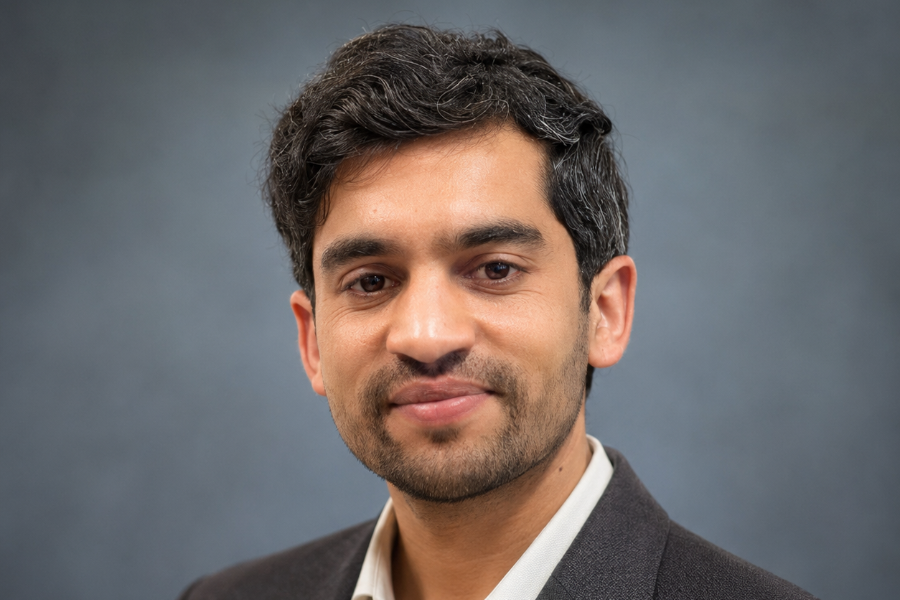
Mansoor Adil
"Advancing knowledge to build resilient communities”
College: Engineering
Degree Program: Civil Engineering
Degree: Doctoral
Why FSU?
At FSU, the Resilient Infrastructure and Disaster Response (RIDER) Center offered a place where that purpose aligned with my interests and expertise. Joining this research community at the FAMU-FSU College of Engineering meant pursuing questions that matter to me: how can infrastructure help keep people safe when they need it most?
Motivation to pursue a graduate degree
I pursued graduate study because I want my knowledge of engineering and geospatial science to help protect people whose lives can change in a single disaster. My background in civil engineering and remote sensing and GIS gave me tools to understand risk, but I wanted to go further to help communities prepare, preserve access to essential services, and recover.
Importance and/or impact of research and work
My doctoral research investigates how wildfire risk translates into transportation disruptions and what those disruptions mean for the communities relying on affected roads. Using geospatial analysis, probabilistic modeling, and wildfire simulation, I study where ignitions may occur, how fires may spread, and which transportation corridors are vulnerable, including how hurricane generated vegetative debris may alter wildfire fuels. I connect these hazards with emergency access, routing, and network recovery to evaluate ways of reducing disruption. Ultimately, I want this work to help agencies act earlier, protect critical connections, and restore access when communities need it most.
Who has been influential in your graduate journey?
Living in Florida, where hurricanes and wildfires threaten communities and the transportation networks they depend on, has given my graduate journey a clear sense of purpose. With guidance from Dr. Neetesh Sharma and Dr. Eren Ozguven, I have come to see a road as more than infrastructure: it can be someone’s route to safety, a connection to medical care, or the path emergency responders need to reach a neighborhood. That connection between hazards, transportation, and people continues to shape the researcher I am becoming.
Career aspirations
My goal is to develop research and decision tools that help build resilient infrastructure and communities, connecting early warning with actions that protect people before disaster strikes. I want to integrate geospatial intelligence, hazard modeling, and optimization to identify vulnerable infrastructure, guide emergency routing, and prioritize restoration after disruptions. Through collaboration with public agencies and communities, I aim to turn these advances into practical decisions that keep essential services accessible and accelerate recovery.
Advice for anyone considering graduate school
Start with a problem that matters to you and ask whose lives could improve if you helped solve it. Find mentors and a research community that will challenge you while helping you connect your strengths with that purpose. Make room for service beyond your research, because working with people can remind you why the work matters and reveal questions you would never find behind a computer screen.
Accomplishments during graduate career
I was selected for the 2026 San Diego Supercomputer Center (SDSC) HPC and Data Science Summer Institute at the University of California San Diego, receiving an NSF-funded award. As the only participant from FSU among 45 selected participants, I received advanced training in high-performance computing, data science, and artificial intelligence to strengthen the computational foundation of my disaster resilience research.
I was also selected for the 2026 NHERI Strategic Program to Accelerate Researchers in Computing (SPARC) at the Texas Advanced Computing Center, University of Texas at Austin, receiving a grant to attend this NSF-supported program. Working with natural hazards researchers and computational experts strengthened my ability to apply large-scale simulations, uncertainty quantification, and advanced computing to infrastructure vulnerability and community resilience.
Organizations you are part of at FSU
Civil and Environmental Engineering Graduate Student Association (CEEGSA) — Secretary, contributing to graduate student leadership and departmental community building.
American Society for Photogrammetry and Remote Sensing (ASPRS) — Treasurer, supporting the organization’s activities and engagement within the geospatial community.
FSU Sustainable Campus Eco-Reps — Participating in a program that connects environmental learning with community service, peer education, and sustainability leadership. This experience connects my interest in environmental resilience with everyday opportunities to contribute to the campus and Tallahassee community.
Community Emergency Response Team (CERT) — Certified member, trained and ready to support community preparedness and assist with disaster response when needed, within my training and in coordination with emergency response teams. This commitment extends my interest in disaster resilience beyond research into practical community service.
Hobbies outside academics
In my spare time, I enjoy painting, hiking, and cycling, which give me space to be creative, explore nature, and recharge. I also enjoy volunteering and taking part in community service activities that allow me to connect with others and contribute to the community.