
Mohana Debnath - Best Call to Action
On a dry day, Rotterdam’s Benthemplein bustles with youths dribbling basketballs or gliding across on skateboards. On a rainy day the same space turns into a marvel of water resources management by collecting stormwater. The open social space then functions as flood infrastructure, offering a significant urban climate solution.
Yet Rotterdam’s successful flood management offers no ready answer for smaller communities across the United States. Due to limited funds, lack of technical expertise, and varying drainage issues; providing adequate protection may be out of reach for some. These celebrated projects might attract recognition, but residents of low-income communities face repeated damage to their homes and livelihoods. Flood protection requires more than a successful design: communities of all races and income need the resources to adapt and sustain it.
Federal and state agencies must fund local assessments, shared engineering expertise, and maintenance before another flood leaves these communities facing the same preventable losses.
Evidence from existing U.S. flood programs shows why this support matters. A study analyzing 2.5 million insurance claims across the continental United States examined the U.S. Federal Emergency Management Agency’s (FEMA) Community Rating System and found uneven attempts to reduce flood losses across communities. Among low-income communities, estimated avoided losses were greater in communities that are predominantly privileged; differences appear to exceed $6,000 per insurance policy in some cases.
Local capacity also determines if communities will be able to implement flood programs. A national study of voluntary floodplain buyouts found out that counties with larger populations and higher incomes were more likely to administer them. While buyouts are different than Rotterdam's stormwater infrastructure, both require local institutions that can take an available approach and turn it into action. Promoting a flood solution without considering capacity thus creates a gap between what is promised and what is implemented.
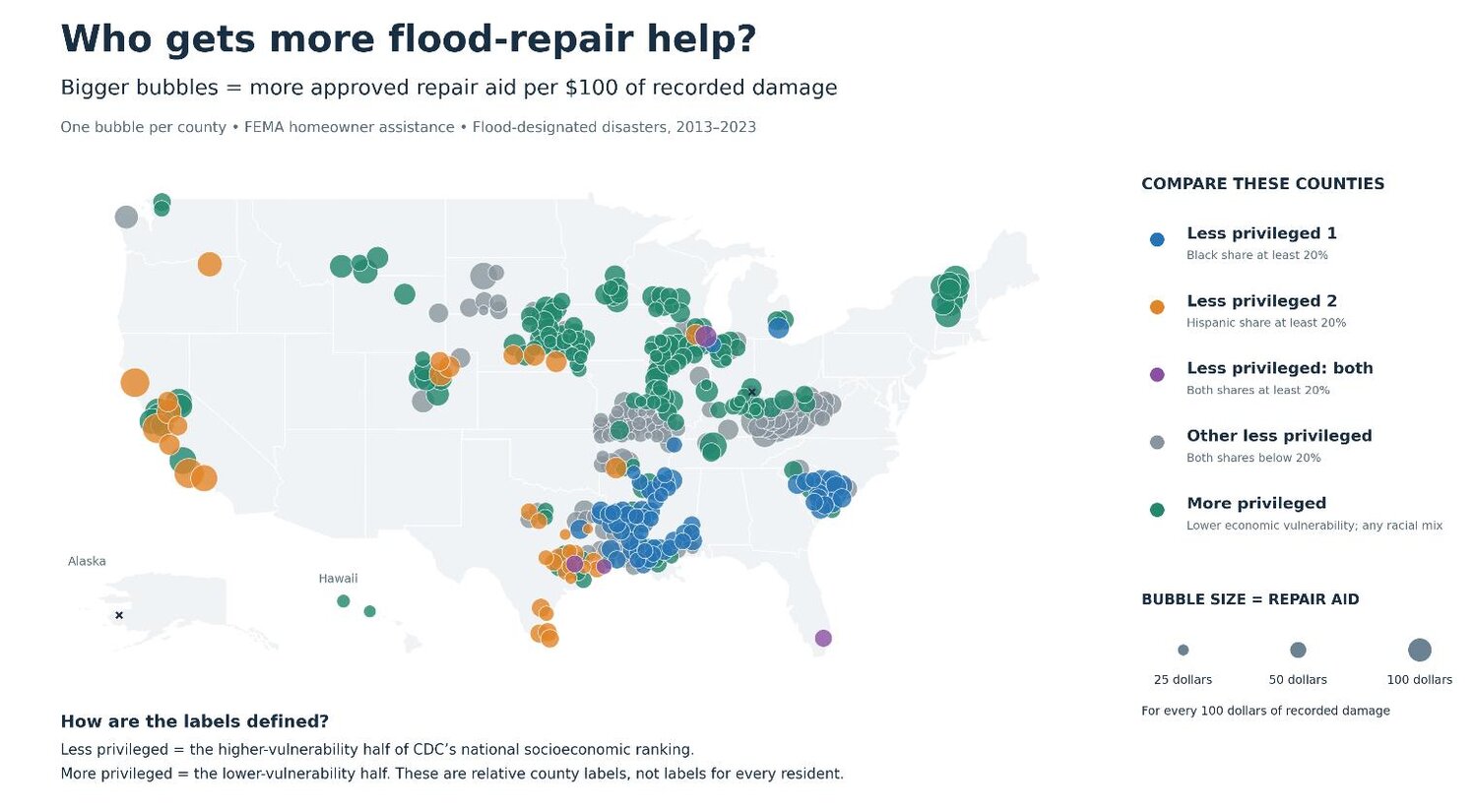
Map and calculations by Mohana Debnath, using FEMA flood-repair assistance data, FEMA disaster declarations, and CDC/ATSDR Social Vulnerability Index 2020
Closing this gap begins with identifying local needs. Federal and State agencies can help determine which communities are at risk and appropriate measures for each community. Once these have been identified, then funding can be secured for all types of communities. One way to address this issue is to fund households facing the greatest flood-risk burdens. In Gloucester City, NJ, researchers modeled funding for elevating flood-prone homes and found that targeting these burdens could increase both equity and economic benefits.
Thus, funding agencies should assess which households benefit from a neighborhood project. Looking beyond average benefits can help identify households whose needs might otherwise be overlooked.
Communities cannot afford to wait for another flood before gaining the expertise to protect themselves. State agencies and universities should provide shared engineering teams to assess local drainage systems, test possible solutions, and plan for ongoing maintenance. Collaboration with neighboring communities can help municipalities share expertise and resources, turning promising measures into protection before the next storm.
Funding must also support implementation over time. Agencies need to ensure that projects fit the local environment, meet the needs of residents and maintain them properly. In addition to funding the project itself, agencies should provide funds for staffing and inspections so that local adaptation is included as an investment.
Examples such as Rotterdam offer inspiration. Turning that inspiration into protection requires federal and state agencies to fund solutions suited to each locality. Secure structures and safe streets must be within every community’s reach before the next flood reveals the cost of leaving people behind.