
Melinda Reed - Most Persuasive Op-Ed
A Court of Thorns and Roses—a darker, action-packed "Beauty and the Beast” retelling set in a faerie realm—has made plenty of lists since it hit shelves in 2015. A New York Times bestseller and BookTok favorite, the fantasy-romance has propelled its author, Sarah J. Maas, into the publishing stratosphere. The title has made more recent lists, too—namely, the American Library Association’s Top 11 Most Challenged Books of 2025, which was announced in April 2026, during National Library Week.
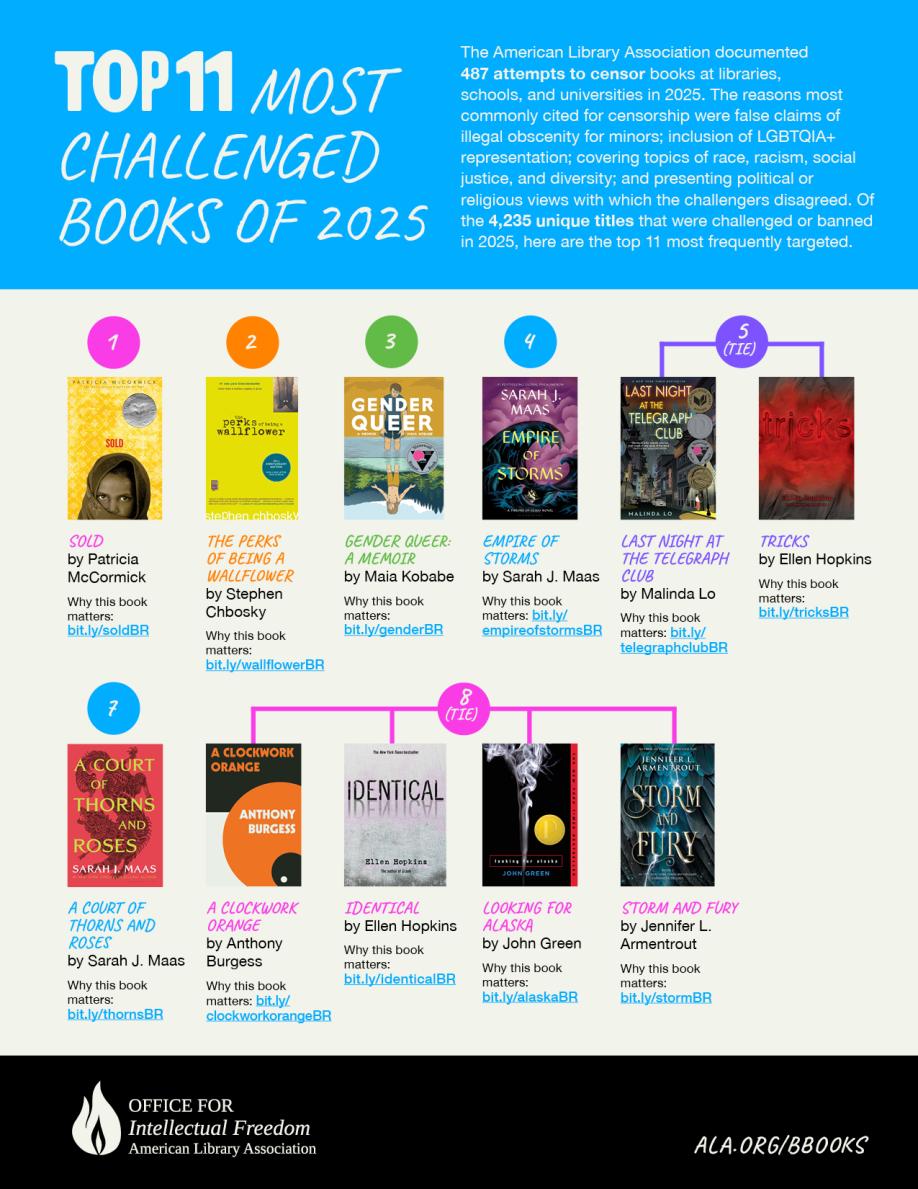
In Florida, which leads the country in school book bans, Maas’s books make up 13 of the over 2,300 bans from school libraries in 2025. Other bestselling romance authors made the list as well, including “Queen of BookTok” Colleen Hoover and rom-com juggernaut Emily Henry.
Given its reputation for putting sex on the page, it’s not surprising that the romance genre makes up a sizable chunk of the bans. Librarians have long acknowledged the need to curate collections that offer developmentally appropriate references or depictions of romance and sex, with publications like School Library Journal providing library professionals suggested age ranges for recently released titles.
But books like A Court of Thorns and Roses have not been removed from shelves because a school librarian has determined them to be inappropriate. If national data holds true for Florida, the truth is that they’ve been targeted by interest groups and politicians, who were behind 92% of 2025’s book challenges.
Prior to 2023, a parent or community member could object to a book if it contained developmentally inappropriate or pornographic content considered harmful to minors. That year, conservatives in the Florida Legislature amended the law to allow objections to any book that “depicts or describes sexual conduct” at all.
In 2026, the bar for banning continues to drop. A recent memo from Florida’s Commissioner of Education advised superintendents to preemptively remove any books with passages that "an adult selector would not be comfortable reading...in a public meeting." This was not just friendly advice, however—districts are required to start weeding their collections or face the loss of state funds.
Discomfort cannot be how we determine which books get to stay in the library. This coded language has already been used to wipe shelves clear of LGBTQ+ representation and the lived experiences of people of color—according to the American Library Association, 40% of the books challenged in 2025 alone provided one or the other or both.
History is uncomfortable. Anatomy is uncomfortable. The truth is uncomfortable. All are necessary to learn.
While the case for discomfort has most often been used to defend classic literature under scrutiny, it should apply here too. Saying so doesn't mean you’re ready to go buy your teenager the latest steamy bestseller—it's acknowledging that if we keep expanding our definition of objectionable, and allowing politicians and parents to make decisions on behalf of educators, we will lose more than just romance books. We’ll be curating school library collections to suit the ideals of those who fund our schools, not those who use them.
With the election just around the corner, now is the time to do your research on state and local candidates, since the people in those positions have the power to change things for the better. If we aren't careful, the definition of “objectionable” will continue to expand and the number of books in school libraries will continue to dwindle. Our students deserve the chance to learn for themselves—even if that occasionally means picking up a romance.