
Abdul Mobin Ibna Hafiz - Honorable Mention: Best Use of Evidence
When we worry about what might contaminate the fruits and vegetables we buy, pesticides and harmful chemicals mostly come to mind. According to a survey, 48% of Americans ranked pesticides among their top three food safety concerns, followed by cancer-causing chemicals (46%) and foodborne illness (43%). But what about plastic particles?
For years, the scientific community has been vocal about plastic pollution in the ocean. But less attention is given to the same contaminant polluting the agricultural lands and we are not doing enough to prevent it.
Researchers have already detected microplastics (particles <5mm) in fruits and vegetables such as apples, pears, and tomatoes. Higher levels of microplastics have also been found in lettuce grown in urban gardens compared to rural gardens.
The concern extends beyond our plates. Studies have found plastic particles in human lungs, placentas, and artery plaque. Patients with plastic particles in their artery plaque faced about 4.5 times the risk of a heart attack, stroke or death over nearly three years. This link does not prove plastic caused the harm, but it is a warning we cannot ignore.
These findings suggest that agricultural lands are not immune to plastic pollution, and the food grown there requires attention as a potential pathway for plastic particles to enter the human body.
Plastics can reach farmland through sewage sludge, plastic mulch, plastic-coated fertilizers, irrigation with treated wastewater, and atmospheric deposition. Scientists have recently focused on many of these sources, yet one important pathway is often ignored by the scientific community: rainwater flowing off city streets onto urban farms.
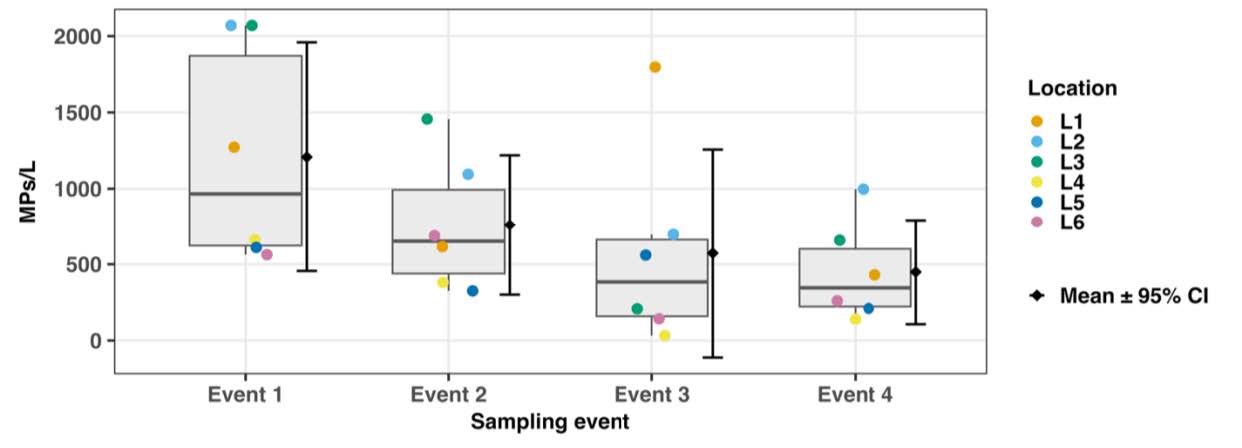
In my dissertation research, I focused on this specific gap. I collected stormwater flowing into an urban agricultural farm in Tallahassee, Florida, and found microplastics in stormwater samples during every rainfall event I studied. Some samples contained more than 2,000 particles/liter (Figure 1), with higher concentrations found in locations near roads, highlighting the need to monitor pollution entering farmland from surrounding urban areas.
The risk extends beyond food safety. Microplastics can alter soil structure, interfere with water and nutrient movement. Eventually this can hamper root development and reduce production. They can also reduce the growth of earthworms and other soil organisms that help to keep soil fertile.
Plastic particles have also been found to act as ‘Trojan horses’, carrying other chemicals such as PFAS – the “forever chemicals”, and heavy metals such as cadmium with them. Once in the soil, these chemicals can be absorbed by plant roots.
We do not know how much of the plastic in our bodies can come from food. Fibers shed by clothing can also enter through the respiratory system. But we cannot filter every breath we take. We can control what goes into our farmland and we should. Here’s how:
- Test farm soil, compost, sludge and incoming runoff for microplastics. We cannot manage what we do not measure.
- Use field measurements to develop models that predict where plastic pollution will accumulate. We have already published a global stormwater microplastic dataset to help researchers identify pollution patterns and develop prevention measures.
- Install green infrastructure such as rain gardens to separate urban farms from surrounding roads that can effectively capture plastic particles from stormwater runoff.
We may not yet understand every consequence of plastic pollution in agriculture, but we have enough evidence to take action. We should not wait for the irreversible damage to happen before taking actions because the land at stake is the land that feeds us.